

Choosing a career in medicine is a major decision for students who dream of becoming doctors. In India, the National Eligibility cum Entrance Test for Undergraduate courses, commonly known as NEET UG, is the main entrance examination for admission to undergraduate medical programmes. Understanding the exam, its eligibility requirements, syllabus and admission process can help students plan their preparation more effectively.
Whether you are studying in Class 11, preparing in Class 12 or taking a drop year, this guide explains the important aspects of NEET UG and the steps involved in pursuing a medical career.
What Is NEET UG Exam?
NEET UG stands for National Eligibility cum Entrance Test (Undergraduate). It is a national-level entrance examination conducted by the National Testing Agency (NTA) for admission to eligible undergraduate medical and related courses in India.
NEET UG is used for admission to MBBS and BDS programmes, along with several other courses covered by the applicable regulations. These include BAMS, BHMS, BUMS and BSMS. NEET scores are also used for other eligible programmes where required by the relevant authorities.
Admission to institutions such as AIIMS and JIPMER for MBBS is also based on NEET UG rather than a separate MBBS entrance examination. Candidates must still satisfy the applicable eligibility, counselling and admission requirements.
The examination helps establish a common entrance process for aspiring medical students across participating institutions to become a doctor.
NEET UG Exam: Important Details
The following table provides a quick overview of NEET UG.
| Particular | Details |
|---|---|
| Full Form | National Eligibility cum Entrance Test (Undergraduate) |
| Exam Authority | National Testing Agency (NTA) |
| Exam Level | National |
| Subjects | Physics, Chemistry and Biology |
| Primary Courses | MBBS and BDS |
| Official Website | Official NEET UG Website |
Candidates should consult the official NEET UG information bulletin for the final examination rules, eligibility conditions, marking scheme and course-specific requirements.
NEET UG Eligibility Criteria
Before filling out the application form, candidates should check whether they meet the eligibility requirements.
1. Educational Qualification
Candidates should have passed or be appearing in the qualifying examination equivalent to Class 12, with Physics, Chemistry, Biology or Biotechnology and English, subject to the applicable regulations.
Students from recognised boards should verify that their subjects and qualifications meet the requirements specified in the official information bulletin.
2. Age Limit
Candidates must satisfy the prescribed minimum age requirement. For NEET UG, the minimum age is 17 years by 31 December of the admission year.
There is generally no upper age limit for appearing in NEET UG under the prevailing eligibility framework. Applicants should check the current bulletin for any applicable clarifications.
3. Minimum Marks in Class 12th
The minimum qualifying examination marks depend on the candidate’s category and the applicable admission regulations. The commonly prescribed requirements for Physics, Chemistry and Biology or Biotechnology are:
| Category | Minimum Marks in PCB |
|---|---|
| General / EWS | 50% |
| SC / ST / OBC-NCL | 40% |
| General-PH / General-PwD | 45% |
These figures should be checked against the current official eligibility rules, particularly for candidates from different educational boards or with equivalent qualifications.
4. Can Class 12 Students Apply for NEET UG?
Yes. Eligible students appearing for their Class 12 qualifying examinations can apply, provided they fulfil the required conditions by the relevant stage of admission.
Students should begin preparing early rather than waiting for their final board examination results.
NEET UG Exam Pattern
Understanding the examination pattern helps candidates organise their revision and practise questions under realistic conditions.
The NEET UG examination uses objective-type multiple-choice questions covering Physics, Chemistry and Biology.
For the examination, candidates should follow the official information bulletin for the applicable question count, duration, marks and instructions.
The standard NEET scoring framework awards marks for correct answers and deducts marks for incorrect answers. Unanswered questions do not ordinarily receive marks or penalties. Candidates should verify the exact marking scheme for their examination year before attempting mock tests.
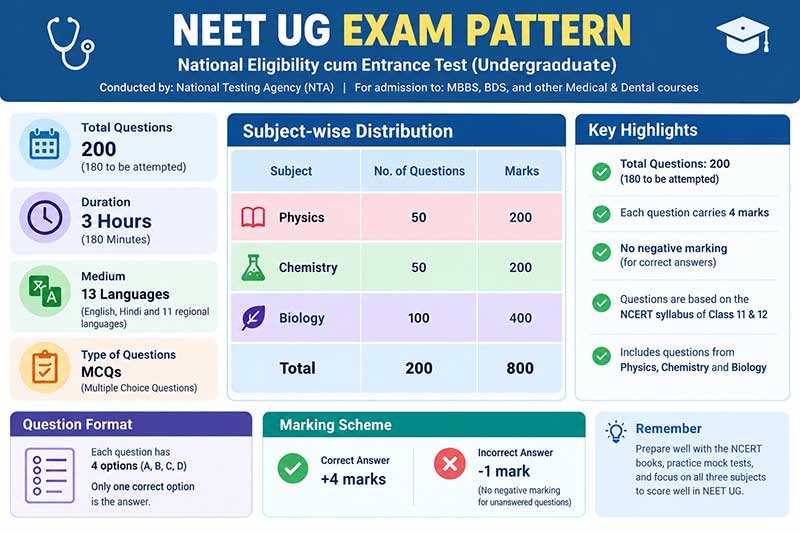
NEET UG Exam Pattern
Subject-Wise Preparation Focus
Physics: Focus on conceptual clarity, numerical problems, formula application and regular practice.
Chemistry: Prepare physical chemistry calculations, inorganic chemistry concepts and organic chemistry reactions and mechanisms.
Biology: Give special attention to NCERT-based concepts, diagrams, terminology, genetics, human physiology, ecology and other prescribed topics.
Accuracy is important because incorrect answers can reduce the final score.
- Physics:Focus on conceptual clarity, numerical problems, formula application and regular practice.
- Chemistry: Prepare physical chemistry calculations, inorganic chemistry concepts and organic chemistry reactions and mechanisms.
- Biology: Give special attention to NCERT-based concepts, diagrams, terminology, genetics, human physiology, ecology and other prescribed topics.
Accuracy is important because incorrect answers can reduce the final score.
NEET UG Syllabus
The NEET UG syllabus is based on Physics, Chemistry and Biology topics prescribed by the relevant authorities. The National Medical Commission (NMC) finalises the syllabus, and candidates should use the officially published syllabus for their examination year.
Physics Syllabus
Physics preparation involves conceptual understanding and numerical problem-solving. Important areas commonly covered include:
- Physics and measurement
- Kinematics and laws of motion
- Work, energy and power
- Rotational motion and gravitation
- Thermodynamics and oscillations
- Electrostatics and current electricity
- Magnetism and electromagnetic induction
- Optics and modern physics
Chemistry Syllabus
Chemistry is generally studied through three major areas.
- Physical Chemistry: Atomic structure, chemical thermodynamics, equilibrium, solutions, electrochemistry and chemical kinetics, according to the prescribed syllabus.
- Organic Chemistry: Basic principles, hydrocarbons, functional groups, organic reactions and relevant compounds included in the syllabus.
- Inorganic Chemistry: Periodic classification, chemical bonding, coordination compounds and other prescribed inorganic topics.
Biology Syllabus
Biology carries substantial importance in NEET UG preparation. Students should build a strong foundation in textbook concepts and practise objective questions regularly.
Important areas include:
- Diversity in the living world
- Cell structure and function
- Plant and human physiology
- Reproduction
- Genetics and evolution
- Biotechnology
- Ecology and environment
How to Prepare for NEET UG
A successful preparation strategy combines conceptual learning, regular revision, question practice and performance analysis.
Step 1: Understand the Syllabus
Download the official syllabus and divide it into manageable chapters. Identify topics that need more attention and prepare a realistic weekly timetable.
Step 2: Strengthen NCERT Fundamentals
NCERT textbooks are an important foundation for NEET UG preparation, particularly in Biology and Chemistry. Read carefully, understand the concepts and revise important diagrams, definitions and examples.
Step 3: Practise MCQs Every Day
Solve chapter-wise questions after completing each topic. Daily practice helps improve speed, accuracy and familiarity with different question styles.
Step 4: Take Regular Mock Tests
Attempt full-length mock tests under examination-like conditions. After each test, review incorrect answers, unanswered questions and time-management problems.
Step 5: Revise Consistently
Prepare short notes for Physics formulas, Chemistry reactions and Biology facts. Schedule revision instead of relying only on learning new chapters.
Step 6: Analyse Your Performance
Maintain a record of mock-test scores and repeated mistakes. Focus your next revision sessions on weak topics rather than repeatedly studying only familiar chapters.
Step 7: Maintain a Balanced Routine
Adequate sleep, breaks, physical activity and a consistent study schedule can help students sustain concentration throughout their preparation.
NEET UG Preparation Strategy for 11th & 12th Students
Starting preparation during school can help students manage board examinations and NEET UG together.
Class 11 Preparation
Class 11 students should focus on building strong concepts in Physics, Chemistry and Biology. Complete school topics thoroughly, solve basic MCQs and revise chapters regularly.
Avoid leaving difficult chapters until the end of the academic year.
Class 12 Preparation
Class 12 students should balance board examination preparation with NEET practice. Study current topics alongside revision of Class 11 chapters.
Include chapter-wise tests, previous-year questions and full-length mock tests in the timetable.
Drop-Year Preparation
Students taking a drop year should first analyse their previous performance. Identify conceptual gaps, revise the full syllabus systematically and set measurable weekly targets.
A drop year is most useful when it follows a structured plan with regular testing and progress reviews.
NEET UG Application Process
- Step 1: Register online: Visit NEET offical website and complete the registration process using the details requested by NTA.
- Step 2: Fill in the application form: Enter personal details, educational information, category details and examination preferences accurately.
- Step 3: Upload the required documents: Upload photographs, signatures and other documents in the formats and sizes specified in the current instructions.
- Step 4: Pay the examination fee: Fees for General 1700INR, General-EWS / OBC-NCL-1600INR, SC / ST / PwBD / PwD / Third Gender- ₹1000INR
- Step 5: Download the confirmation page: Save the completed application confirmation and payment receipt for future reference
NEET UG Counselling and Medical College Admission
Medical Campus
Qualifying NEET UG does not guarantee an MBBS seat. Admission depends on rank, category, seat availability and counselling.
The admission process includes:
- Result and Rank: Check your NEET UG result.
- Counselling Registration: Register with the relevant authority.
- Choice Filling: Select preferred colleges and courses.
- Seat Allotment: Seats are allocated based on merit and availability.
- Reporting: Complete document verification and admission formalities.
The Medical Counselling Committee (MCC) manages designated counselling processes, while state authorities handle applicable state quota admissions.
Courses Available Through NEET UG
- MBBS: Modern medicine
- BDS: Dentistry
- BAMS: Ayurveda
- BHMS: Homoeopathy
- BUMS: Unani medicine
- BSMS: Siddha medicine
Course eligibility depends on applicable regulations.
Career Opportunities After NEET UG
Students who secure admission to a medical programme can build careers in clinical practice, healthcare services, research, teaching and specialised fields.
After completing MBBS and fulfilling the applicable internship and registration requirements, graduates can pursue further medical training or eligible professional opportunities.
BDS graduates can pursue dental practice and postgraduate dental education. Graduates of other recognised healthcare programmes can explore the career pathways permitted by their qualifications and professional regulations.
The right course should be chosen according to a student’s interests, aptitude, professional goals and understanding of the responsibilities involved in patient care.
Common Mistakes NEET UG Aspirants Should Avoid
- Ignoring the official syllabus and NCERT textbooks.
- Skipping mock tests and regular revision.
- Using too many study resources.
- Neglecting Class 12 board examinations.
- Trusting unofficial exam updates.
- Assuming that qualifying NEET guarantees an MBBS seat.